

Charter School Performance Dashboards
Welcome to the Commission's performance dashboards. These dashboards provide comprehensive data on charter school performance in Hawaii.
Select a dashboard to begin:
- Academic Performance Framework Dashboard
- Financial Performance Framework Dashboard
- Organizational Performance Framework Dashboard
- Standardized Assessments - Strive HI Dashboard
- Academic Performance Framework Dashboard
- Financial Performance Framework Dashboard
- Organizational Performance Framework Dashboard
- Standardized Assessments - Strive HI Dashboard
The Academic Performance Framework (APF) is a comprehensive evaluation system that measures charter school success through both statewide academic standards and mission-aligned initiatives unique to each school's community.
The APF serves three critical purposes: annual monitoring of school performance, identification of areas for improvement and potential interventions, and informing charter renewal and revocation decisions. This balanced approach recognizes that charter schools serve diverse communities with distinct educational visions while maintaining accountability to rigorous academic standards.
Framework Components
The APF evaluates schools across four indicators totaling 115 possible points:
Required Indicators (100 points):
- Indicator 1: Mission-Aligned Initiative (30 points) - Measures how effectively schools implement their unique educational vision and mission-focused goals through documentation, data, and narrative assessment
- Indicator 2: Standardized Assessments - Strive HI (70 points) - Evaluates student performance on state assessments including absolute achievement, growth over time, achievement gap closure, post-secondary readiness, chronic absenteeism, and school climate
Supplemental Indicators (15 points):
- Indicator 3: Comparative Performance (6 points) - Compares charter school performance with traditional public schools at the complex area, complex, and charter school levels
- Indicator 4: School-Reported Data (9 points) - Tracks student progress throughout the year using site-relevant diagnostic tools
Performance Standards
Schools demonstrate successful performance by earning an average of 73 points or higher over the first four years of their charter contract. Schools showing consistent improvement over time may also meet renewal standards at the Commission's discretion.
Why This Dashboard Matters
This interactive dashboard revolutionizes how academic performance data is shared and analyzed across Hawaiʻi's charter school community. For the first time, comprehensive academic performance data spanning all four indicators is available in one accessible, visual platform:
- Families and prospective parents can compare schools' academic performance, review how well schools fulfill their unique missions, and make informed enrollment decisions based on both standardized test results and mission-specific achievements
- School leaders and educators can track their performance across all indicators, identify strengths and areas for growth, benchmark against portfolio averages, and monitor progress toward the 73-point renewal threshold throughout their charter term
- Governing boards can fulfill oversight responsibilities with clear data visualizations, understand how their school performs relative to peers, and make strategic decisions about resource allocation and program investments
- Students and community members can see evidence of how charter schools serve their specific communities through mission-aligned work while maintaining academic rigor
- Commission staff can provide targeted support based on indicator-specific data, identify schools needing intervention before renewal decisions, and track portfolio-wide trends over time
- Commissioners can fulfill their authorizing responsibilities with comprehensive academic data, make informed decisions about charter renewals based on multi-year performance trends, ensure schools meet both state standards and mission-specific goals, and evaluate the effectiveness of the dual accountability model.
- Researchers and policymakers can evaluate the effectiveness of the dual accountability model (standardized + mission-aligned), analyze whether charter schools deliver on their promises of innovation, and assess the sector's overall academic health
The dashboard makes the often-complex APF scoring system transparent and understandable, showing not just final scores but the underlying data that demonstrates how charter schools balance state accountability requirements with their commitment to serving diverse communities with innovative educational approaches. This visibility strengthens the charter school value proposition: rigorous accountability combined with flexibility to meet unique community needs.
Financial Performance Framework
The Financial Performance Framework (FPF) is a comprehensive risk-based assessment tool that evaluates charter school financial health and viability through industry-standard financial measures, ensuring fiscal accountability and long-term sustainability.
The FPF serves as the primary tool for assessing the financial health and viability of charter schools, providing a financial frame of reference based on current and past performance. Using industry-standard measures including ratios and variances, the framework provides a holistic view of each school's near-term financial health, mid-term capacity, and long-term sustainability. This risk-based approach enables early identification of financial challenges and targeted support before problems become critical.
Framework Components
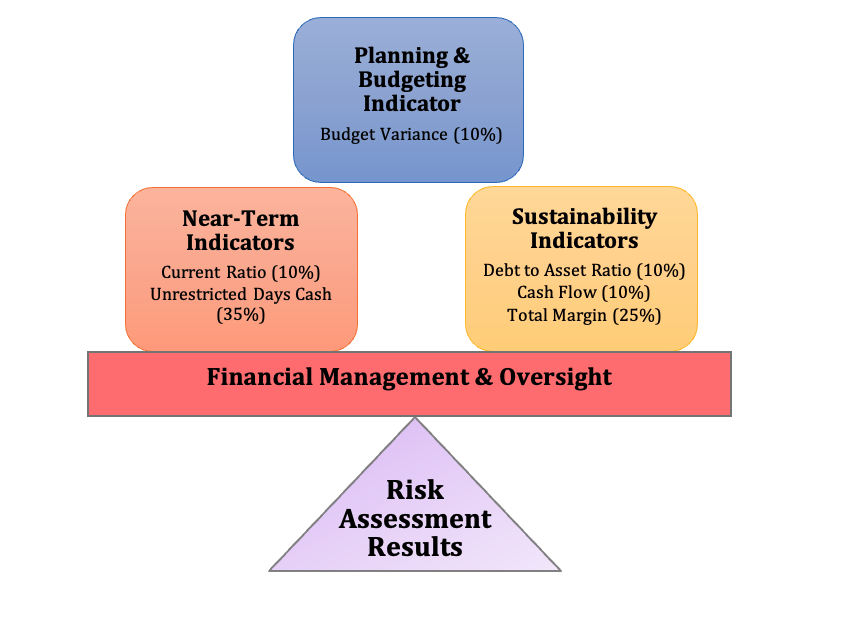
The FPF evaluates schools across six financial indicators using National Association of Charter School Authorizers (NACSA) standards, with each indicator assessed on a scale of 1 to 5 (1 being lowest risk, 5 being highest risk):
Near-Term Indicators:
- Current Ratio (10%) - Measures a school's ability to pay its obligations over the next twelve months by comparing current assets to current liabilities
- Unrestricted Days Cash (35%) - Indicates the number of days a school can pay current expenses without additional cash inflow, the most heavily weighted indicator due to its critical importance
Sustainability Indicators:
- Debt to Asset Ratio (10%) - Compares financial liabilities against assets owned; lower ratios indicate stronger financial health
- Cash Flow (10%) - Tracks year-over-year changes in cash balance, providing insight into long-term stability
- Total Margin (25%) - Measures the surplus or deficit a school yields from total revenues, the second most heavily weighted indicator
Planning & Budgeting Indicator:
- Budget Variance (10%) - Compares actual versus projected revenues, assessing the accuracy of budget planning
Risk Assessment Calculation
The overall risk assessment uses a balanced weighted formula:
(Current Ratio × 0.10) + (Unrestricted Days Cash × 0.35) + (Debt to Asset Ratio × 0.10) + (Cash Flow × 0.10) + (Total Margin × 0.25) + (Budget Variance × 0.10)
Results are categorized into five risk levels:
- Low Risk (1)
- Acceptable Risk (2)
- Moderate Risk (3)
- High Risk (4)
- Significant Risk (5)
Performance Standards
Schools demonstrating heightened financial risk receive closer monitoring and may be required to develop corrective action plans. The Commission conducts quarterly financial reviews and annual audit assessments, adjusting oversight intensity based on risk levels. Schools receive targeted technical assistance to address specific indicators causing elevated risk.
Why This Dashboard Matters
This interactive dashboard transforms how financial performance data is shared and utilized across the charter school ecosystem. Previously, financial data was available only through individual school audits and Commission reports. Now, this centralized platform provides unprecedented transparency and analytical capabilities:
- Families and prospective parents can evaluate a school's financial stability before enrollment, ensuring their children attend fiscally sound institutions
- School leaders and business managers can monitor their financial health in real-time, benchmark against peer schools, identify early warning signs requiring corrective action, and track progress across all six indicators throughout the year.
- Governing boards can fulfill their fiduciary duties with data-driven insights, understand how their school's financial position compares to portfolio standards, make strategic decisions about reserve building and capital investments, and demonstrate fiscal responsibility to their communities.
- Commissioners can fulfill their oversight responsibilities with comprehensive financial data, make informed decisions about charter renewals and interventions, and ensure public funds are managed responsibly across the charter sector
- Commission staff can prioritize technical assistance and interventions based on objective risk assessments rather than reactive problem-solving
- Researchers and policymakers can analyze sector-wide financial trends, evaluate the adequacy of per-pupil funding, and identify systemic challenges
The dashboard makes complex financial data transparent and understandable through intuitive visualizations and risk indicators, transforming financial accountability from expert-only analysis to accessible public information. By showing not just final risk scores but the underlying indicators driving those assessments, the dashboard enables stakeholders at all levels to understand charter school financial health and supports data-informed decision-making. This visibility strengthens public confidence in charter school fiscal management and demonstrates the Commission's commitment to protecting both public investment and educational opportunity.
Organizational Performance Framework
The Organizational Performance Framework (OPF) is a comprehensive compliance evaluation system that ensures charter schools meet all applicable federal, state, and local laws, regulations, and contractual requirements while maintaining sound operational practices and governance.
The OPF serves as the means by which the Commission protects the public interest. The framework requires schools to comply with all applicable laws, timely complete required documentation, implement effective policies and procedures, and maintain accessible governance practices that demonstrate transparency and accountability to families and communities.
Framework Components
The OPF evaluates charter schools across sixteen organizational articles encompassing 42 annual compliance tasks:
Governance and Mission:
- School Charter and Mission - Operating in accordance with approved mission and charter provisions
- Governance - Maintaining effective governing board operations, meeting requirements, and transparent public reporting
Academic and Performance Management:
- School Performance - Meeting performance framework requirements and responding to Commission oversight
- Academic Performance - Implementing state academic standards, administering required assessments, and serving all student populations
Financial Operations:
- Financial Management - Maintaining sound fiscal practices, accurate financial records, appropriate policies, and timely reporting
Student Services:
- Admission, Enrollment, and Attendance - Following lawful admission procedures, maintaining open enrollment, and tracking attendance
- Student Records and Data - Ensuring accurate data reporting and protecting student privacy
- Health and Safety - Maintaining safe learning environments and complying with health requirements
Operations and Facilities:
- General Operation of School - Managing records, implementing conduct policies, and establishing complaint processes
- School Facilities - Confirming lawful occupancy and compliance with safety codes
- Educational Service Provider - Managing and overseeing ESP contracts when applicable
Personnel Management:
- Personnel and Employment - Conducting background checks, complying with collective bargaining, hiring credentialed teachers, and maintaining nondiscrimination policies
Legal and Administrative:
- Insurance and Legal Liabilities - Maintaining required coverage
- Commission Oversight and Responsibilities - Providing records access and cooperating with monitoring
- Notice - Promptly notifying the Commission of emergencies and mandatory reportable incidents
- Additional Obligations - Meeting any additional contractual requirements
Performance Standards
Schools demonstrate successful organizational performance by earning "Meets" evaluations across all framework indicators. Schools receiving "Does Not Meet" evaluations receive a Notice of Concern requiring a corrective action plan. Three or more successive years of "Does Not Meet" evaluations in the same category may result in a Notice of Deficiency and potential intervention.
Why This Dashboard Matters
This interactive dashboard represents a significant advancement in transparency and accessibility of charter school performance data. For the first time, families, school leaders, policymakers, and community members can access real-time organizational compliance data across all 37 charter schools in one centralized location. The dashboard enables:
- Parents and families to review whether schools meet operational and safety requirements before enrollment decisions
- School leaders to benchmark their compliance against portfolio-wide standards and identify areas for improvement
- Governing boards to monitor their school's organizational health and fulfill oversight responsibilities
- Commission staff to provide targeted technical assistance based on data-driven insights
- Policymakers and researchers to analyze system-wide trends and evaluate the effectiveness of oversight practices
By making this data publicly accessible, the Commission demonstrates its commitment to transparent authorizing practices and empowers all stakeholders to engage meaningfully in charter school accountability.


Ka ʻElele: SPCSC's Weekly E-Newsletters
Sign up to receive Ka ʻElele, the official e-newsletter of the Hawaii State Public Charter School Commission/ʻAha Kula Hoʻāmana. Ka ʻElele covers a multitude of topics and issues relevant to Hawaii's public charter schools.